

La Loi et la Voie chez Ibn' Arabî
Pour Ibn'Arabî, comme tous les grands maîtres soufis, la lettre et l'esprit de la tradition, l'ésotérisme et l'exotérisme de l'Islam ne s'opposent pas, nous dit-il. L'esprit de la Loi sacrée est bien tributaire, au contraire, de la bonne connaissance de la lettre. Est ignorant, à ses yeux, celui qui prétend qu'on ne peut accéder à la connaissance véritable ou encore celui qui pense qu'on peut ne pas se soumettre à la Loi. Il ne saurait, en effet, y avoir de Voie intérieure sans appui sur la Loi sacrée qui encadre et oriente celui qui cherche à canaliser ses pulsions afin de s'élever spirituellement.
abonnez-vous pour un accès à tout le catalogue !
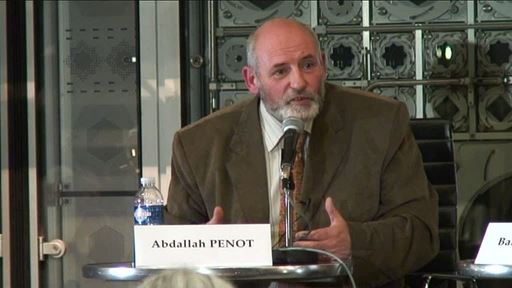
Extrait de la vidéo
I would like to talk a little bit about Duato, Margetti and Le Bon. You should know that we have tried to present them for a while as a sort of martini, that is to say, a sort of February martini that would have been marked with the name of the law, which is a totally false presentation. I would like to know, as you may have heard in the lectures of the past, that Margetti is a realist, a man who studied the Koran, a man who was inspired by young people, sometimes pitiful, sometimes pitiful.
He was a man who, at the time, decided that he could never do anything the other way around. From that day on, if I think of something and leave it, it's good for me, but the next day it's not good, the next day it's not good. So he lived in an almost continual state of mind. It's brilliant, it's not at all like the Illuminati, who put texts, philosophy, who try to draw purely speculative conclusions.
It's all that. It's a man, like all writers of his time, who lives his religion, and who lived it in an intense way. There is a little bit of a difference, which is that he says, I have learned a new understanding of the law. I have said, I am not a supporter of new religions, I have learned a new understanding of the law, I have said, I am not a supporter of new religions, but I have learned a new understanding of the law.
And what is important, is that, in this language, the law is the law, it is not something different. It is sometimes, in a rather surprising way, it is something that we will not take sometimes as an exoderist of music, in some cases. That is to say that we will assimilate it to what is called a zoroelite. You know, there were juridical schools in Islam, there were several.
And there was a juridical school in Mongolia, which was particularly attached to the letter of the law, which went up to a jurist, whose name was Davout, a zoroelite. And often, we thought wrongly of this zoroelite, because he was part of his school, because he took the letters, the texts to the letter, very often. And this shows an evidence of a zoroelite, that he is everything, except someone who puts the texts in question, who gets confused.
So, he takes the texts as they are, and for him, the very foundation of spirituality is in the very body of the text. So, let's take a few examples, which can also help us understand our own Islam. For example, the famous verse of the seven heavens of Isha, which is the foundation of the divine transcendence in Islam, there is nothing that resembles it. As we say, there is nothing that resembles God, there is nothing that is completely different from his creation, he transcends everything, that is clear.
All the esotericists and the Sufis themselves, before the Marawis, interpret this verse in the clearest way, that is to say, how can we define it? Transcendence of God for the Marawis. So, normally, we take the text in this more absolute literality, and sometimes, it will go in this direction, and sometimes, it will mean that if we take the text as it is, in Isha, there is nothing, because, as he said, there is nothing that is completely different from his creation.
Excuse me. So, we say that there is nothing that is comparable to his creation, which means, in fact, that God has a semblance, and this semblance, no one can resemble it. Who is this semblance? This semblance is the prophetic example, it is in the universe, so there was the question earlier, we will come back to it later.
This semblance is the number of gods on earth, according to our religion, which is a religion of God, because it is in our Hadith that God God created in his own name, and Saint Abraham said, you see what the text says, it is not that nothing is like God, it is the opposite, that God has a semblance, and that this semblance, no one can resemble it. So, indeed, it is a proposition that can cause a scandal, but, if we look at the text, this is what is important, and rigorously conforms to what is said and to what is written.
Very often, in Saint Abraham, we will have, in this exegetical process, a kind of literalism, which could almost seem to be true, but which, in fact, will end up in the heart of spirituality. For example, an interpretation by Ludovic, which reveals the spiritual meaning in the heart of literality, this is what is important, it is that when there is a renaissance, the being is separated from the other.
You have, for example, the Qur'anic verse, with, literally, the versatility comes with the versatility comes the facility. This text has been interpreted differently, however, it translates, by the way, by the translators, after the time, in the future, in memory, it is with. It is not after. It is in the heart of difficulty that you will find salvation.
Why? Because in the heart of the difficulty which is sent to you by God, you have divine presence. So if you are looking for the presence of God, you will find it in everything, in all manifestations, you will find God. And in the heart of the difficulty which seems to you, in relation to the testimony of God, which rejects the apparent sense to approach the hidden sense.
No, it is someone who makes in the apparent sense, the hidden sense. Another example, because we could give infinities, the prayer accomplished with the siwak is superior to 27 times the prayer accomplished without siwak. So the siwak is a kind of for the muslims among us, it is a kind of toothbrush, which existed as a prophet, it is a wood which is quite soft and which allows to brush the teeth, to clean the mouth, at the time it was a toothbrush.
Well... A bio toothbrush. A bio toothbrush, exactly. And it turns out that in the wood which was used at the time in Arabia, there was a kind of a kind of material which is recognized for its antiseptic properties, so which is more effective.
So, if we take a journalist, who says siwak, which is a wordplay, siwak means without you, without your ego. If you pray to get rid of your ego, your prayer will be far superior to the one you will do when you will have done it with your ego. So we see that it is a magnetism, it is not at all an exegesis, it includes the meaning of the text. It includes the meaning of the text, it admits the literal interpretation and it adds, as he said, as you explained earlier, it adds to the meaning that others may have seen, in any case that they had not expressed, or that others had simply not seen.
And that's where we can't say in any case that it is a kind of esoteric which would be considered in a way a little bit