

Comment révolutionner la conscience humaine 1/2?
Comment créer une révolution de la conscience ? Pour répondre à cette fondamentale – et plus que jamais actuelle - question, un philosophe, Ervin Laszlo et un enseignant spirituel, Andrew Cohen, se sont réunis à Paris dans le cadre d’une soirée exceptionnelle organisée par EnlightenNext France. Pour Andrew Cohen, le changement de société, ou de paradigme, passe en premier lieu par un changement au sein de chaque homme et femme. « Avant de montrer la paille qui est dans l’œil de ton voisin, regarde plutôt la poutre qui est dans le tien ».
abonnez-vous pour un accès à tout le catalogue !
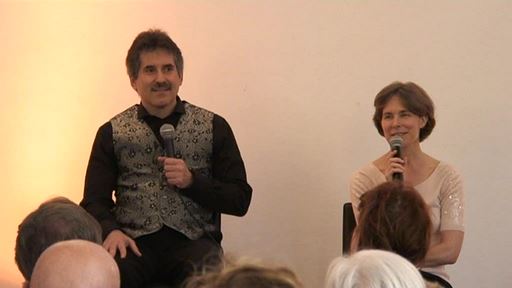
Cohen nous incite à nous affranchir de nos automatismes qu’un égo inférieur tend à multiplier. Autant de systèmes de protection prétendument « sécurisants » mais qui se révèlent en fait sclérosants et mènent inéluctablement à la myopie, ou pire…. la cécité, dont le monde actuel serait frappée. « Au royaume des aveugles les borgnes seront rois » est-il aussi rappelé.
Andrew Cohen la dignité de l’homme se trouve dans sa capacité d’auto-réflexion : « Je suis conscient d’être conscient ». Et de toujours se comporter comme tel, en pleine conscience : faire comme si chaque pensée, chaque acte était en relation avec un ordre supérieur ; « cosmique » oserions-nous, bien que ce terme ait souvent été usité par le New-Age.
Selon Andrew Cohen , ce processus cosmique a commencé il y a dix-neuf milliards d’années, et l’Homme, petit dernier mais au combien responsable du devenir de cette arche, est passé par des stades d’éveil évolutif successifs : égocentrique lorsque ses préoccupations se limitaient à la chasse et à la cueillette, ethnocentrique lorsque les ethnies, l’élevage, les clans se dessinèrent, mythocentrique lorsque les polythéismes s’estompèrent au profit de figures tutélaires, principalement religieuses.

Puis vint le siècle des Lumières et pour la première fois, l’Homme tenta de se hisser à une dimension universelle qu’Andrew Cohen définit comme « world-centric » ou « géo-centrique ». Avant de se déclarer citoyen d’une nation en particulier, cet Homme se comprenait avant tout comme appartenir au monde.
Deux siècles se sont écoulés, et face à l’accélération du temps, de l’histoire, et de la technologie, la délicate question est de définir avec acuité la situation actuelle de l’homme : la postmodernité a-t-elle accouché d’un Nouvel Homme que Cohen aimerait pouvoir nommer l’homme Cosmos-centrique ?
Ou bien le Nouvel Homme du XXIème siècle ne serait en fait qu’un simple consommateur-électeur, dont la principale préoccupation ne se limite qu’à ce qu’il va entreprendre dans les sept jours … et dont le représentant politique, conséquemment, cultive la même vision du monde : égotique et à très court-terme …?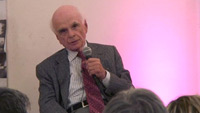
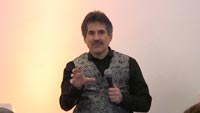
L’homme cosmos-centrique, pour Andrew Cohen, est le niveau d’évolution le plus élevé que l’Homme n’a jamais connu et les nombreux enseignements et conférences qu’il donne à travers le monde prônent l’instauration d’une nouvelle ère, celle de la révolution des consciences, où « l’éveil évolutif » et la grandeur de l’Homme pourront pleinement se réaliser... Autant l’approche d’Andrew Cohen est spirituelle puis concrète, autant celle d’Ervin Laszlo est d’abord pragmatique puis philosophique. Autre parcours, autre sensibilité… même si leurs conclusions se rejoignent. En rappelant l’adage d’Einstein : « on ne peut pas régler un problème avec le même état d’esprit du moment où le problème est survenu… » Ervin Laszlo nous met solennellement en garde « nous sommes capables de nous tuer nous-mêmes et d’éradiquer tout ce qui nous entoure …» et nous exhorte, lui aussi, à l’action.
Ervin Laszlo appelle de ses vœux une révolution de la conscience, comme fil rouge pour une action dans la discontinuité : l’avenir ne sera jamais anticipé par des spécialistes de la prévision, depuis leur bureau. Pour Ervin Laszlo, prévision est synonyme de capitulation : notre futur n’est pas prédictible, il est à créer ! …
Souhaitez-vous vous familiariser avec la pensée de ces deux sages et peut-être passer du stade de spectateur à celui d’acteur de ce changement ?
Eléments de réponse dans cette vidéo de 86 min (disponible en 2 volets) enregistrée au Forum 104. Nos remerciements à EnlightenNext France et Ervin Laszlo (Club de Budapest & Université Giordano Bruno).
Extrait de la vidéo
Good evening, everybody. What a beautiful time to be in Paris. You'd almost think that to be in Paris in the beginning of the spring, you'd almost think that humanity had no problems. So in Italy they call it the dolce vita, right?
So what do you call it in French? The sweetness of life. So to be in Paris in the beginning of the spring is very sweet. And there's almost the appearance that everything is perfect.
Yeah. People are dressed beautifully. French food and French wine are so good. The standard of living is so high.
Things look good. So what we want to talk about today is creating a revolution in human consciousness that can help us to create the future. Sound like a good idea? Because to be honest, I often find that the future is not something that most people think about very often.
Most people think about how can I survive until next week. But the idea of creating a better future or a new future is not something that most people think about, I believe. So Erwin and I, we want to have a dialogue together this evening about what would it be like to begin to entertain the possibility of creating a brand new future, a future that doesn't exist yet. Does that sound like a good idea?
So in order to become interested in the future, we have to experience dissatisfaction with the way things are. So this has to be not only with our own personal lives, not only with the nature of our own personal lives, but also with the state of our culture and also the state of our world. So unless we experience an intense state of dissatisfaction, it's very difficult to find the energy to create something new.
So how many people are intensely dissatisfied with the way things are? So that shows there's less than half the people. Let's try one more time. So how many people are intensely dissatisfied?
You have to be honest. Are you really intensely dissatisfied? Okay, that's very good. Bravo, bravo.
That's very good. That's very positive news. So I think what we want to speak about today is the whole issue of how we think about what it means to be a human being. What we want to speak about is how big is the context that we think about what it means to be a human being, what we believe it means to be ourselves.
So for many of us, the context tends to be very narrow, very personal, and for example, for an American person like myself, when I come to France, I'm aware there's a traditional culture I'm coming into. It's a culture of great traditions. It's a culture that's very invested in its own history and its own tradition. Right?
Isn't that true? The French are very proud of their history and of their traditions. The other, also, France is a culture that is what could be considered the modernist stage of cultural development. You understand?
So French culture as a whole has rejected the great religious traditions of the past and has embraced science and materialism. Right? So there's a culture of traditionalism, traditional values, traditional values at the level of culture. Isn't that right?
Traditional values at the level of culture and also a belief in modernism. I often say that post-modernism, because the cultural shift has gone from traditional to modern to post-modern, I often say post-modernism hasn't really arrived in France yet. You follow? Yeah.
So if we're in France and we're going to be speaking about the future, we have to speak about taking the leap from modernism to post-modernism and then the leap beyond post-modernism to post-post-modernism. So what we're speaking about here are world views. A world view. When a human being sees the world around them, they see the world through perspectives.
When you see the world, when I see the world, what we see are the perspectives that create the picture of the world that we see. You follow? So what our culture teaches us are shared values and shared perspectives that teach us and inform us how the world appears to us. So if we're speaking about a transformation of consciousness, that's about creating the future, we're speaking about what it would mean to embrace bigger perspectives and new values that would enable us to include more of the world and more of the universe in the way that we see.