

Tracé des enceintes mégalithiques
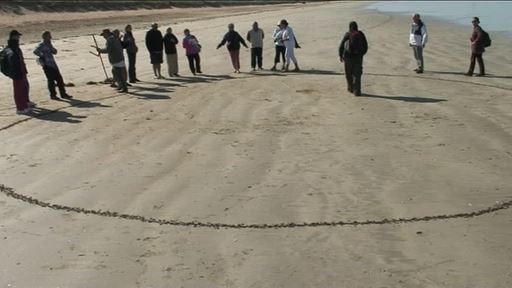
Dans le cadre de l'événement "Solstice d'été à Plouharnel" , Robin Heath nous montre ici comment les hommes du néolitique traçaient les enceintes mégalithiques.
D'après les travaux du professeur Alexander Thom sur près de 600 cercles concernant l'unité de mesure et les tracés, il tente de nous faire redécouvrir une méthode simple et élémentaire qui permettait de dessiner les formes géométriques des sites les plus fameux.
Un voyage qui nous entraînera au coeur des mystères des constructeurs mégalithiques.
abonnez-vous pour un accès à tout le catalogue !
Quelle est l'unité de mesure commune à tous les sites mégalithiques ?
Comment les anciens traçaient les enceintes ?
Réponse de Robin Heath dans ce reportage de 74 minutes.
Extrait de la vidéo
When Professor Tom did a survey, he measured these circles, because he was aware of the world class engineer. He asked the most fundamental question an engineer wants to know. Were all these 600 circles made using a unit of length? If they were, what was it?
And what was the best way of determining the unit of length accurately? He was at Oxford University where he was the head of engineering. So after he had surveyed good condition surviving stone circles, and had done, I think, 169 of them, he had enough data to telephone from the university, the maths department. And he spoke to two people, eventually, and they were the top statisticians of the mid-century.
Because he wanted them to do the analysis. So he did not have a priori. Alexander Tom discovered several things, and this may be, for most of you, one of the most important realizations. If we just use this measure here.
Half of all circles, are true circles. The others have different geometries. And we'll cover those later. Because they are fascinating.
There is many cosmic, such a bad word to use. There are many astronomical constants built into the other shapes. Now we see the circle today, many people can very easily see that the circle is the sky. And we, today, we use symbols to identify which part of the sky we are talking about.
We know that we could identify stars in the sign of Aries, Taurus, Capricorn, Aquarius and Pisces. That's the water carrier. So, these here, we could represent the circle as being the circle of the year. In which case, from this, these are the, round this circle, we've got 12 months, except there are.
And you're all familiar with that model. You're all happy with that model. Now, Professor Tom didn't even consider this. What he was considering, was to make an accurate survey of all the stones.
And we haven't got many stones on this beach. So I will mark maybe where the stones are. And he discovered several things. If you're interested, I'll tell you some of the technical details.
Because he was an engineer, he was very used on, it was a normal part of his job, to determine the repeated accuracy of components made mass production. Such that, if we were to take, for example, the crankshaft of a car, it's possible to take 100 pieces and there will be a slight variation in size. And indeed, in modern times, the big advance in motor car engineering, in modern times, has been the increase in precision.
So, Professor Tom was already totally familiar with that process. So, after measuring many circles, and it would be good to remember that many of the plans he drew, were the only plans ever done. So, all the archaeologists that whine and whinge about, or ignore Professor Tom, still have all his diagrams in their libraries. And several archaeologists have said that they are the best plans ever done of an archaeologist.