

Stonehenge, comment les hommes prédisaient les éclipses
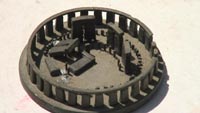
Robin Heath travaille depuis plus de 25 ans sur les unités de mesure des sites mégalithiques. Grace à celles-ci, il est parvenu à en dégager une signification pratique et symbolique.Tel un jeu d'enfant, s'aidant d'une maquette de Stonehenge, de deux balles de golf symbolisant le soleil et la lune, ainsi que d'une carte zodiacale, il nous démontre que les premières constructions du site de Stonehenge ont été construites non seulement pour célébrer les levers de soleil au solstice d'été mais encore pour prédire les éclipses.
abonnez-vous pour un accès à tout le catalogue !
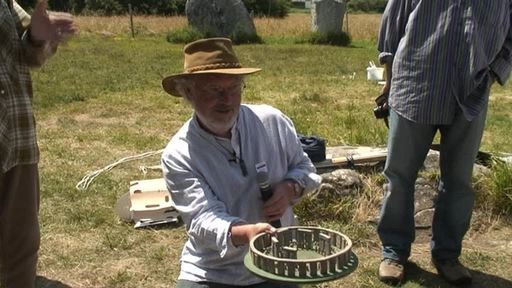
Les questions que soulèvent Robin Heath sont de différents ordres :
- Fonctionnelles pour quelles raisons les hommes du néolithique construisaient ces calendriers de pierre gigantesques ?
- Anthropologique: ces hommes, qu'on suppose ne se préoccuper qu'à des tâches de "chasseur-cueilleur", étaient en mesure d'évaluer avec précision la durée d'une journée, d'une semaine, d'une année et pouvaient prédire les éclipses.
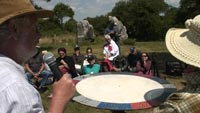
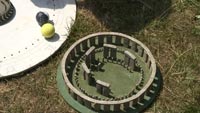
- Spirituelle: quelles significations symboliques attribuer à ces constructions dont la pérennité et la disposition sont en droit de laisser l'homme moderne songeur: ne seraient-elles pas une tentative de matérialisation d'une harmonie céleste? Et si c'est le cas, quel est leur message ?
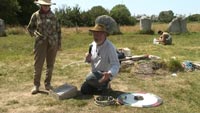
A vous de vous faire une idée grâce à ce reportage de 51 minutes tourné lors de l'événement "Solstice d'été à Plouharnel" .
Extrait de la vidéo
Today I'm going to give you an account of the methods by which eclipses can be measured without modern technology, in order to help you to understand how the shapes and the number ratios which are found at many megalithic sites appear to suggest that the megalithic people were measuring the times when eclipses would occur. When eclipses would occur, predicted eclipses. Now to understand this, we need to understand several things.
It is very easy to project our civilisation back in time. We all do it. The cartoon that shows the man in the bare skin is a grotesque caricature. And similarly, the idea of people building these with spaceships is considered to be bizarre too.
Now in these cases, I'm a scientist, I was a research scientist for many years, and the best way to find out what is the connection between eclipses and these sites, is to find evidence. Much evidence. Preferably evidence repeated over many sites. And to let this evidence be looked at by other people.
And I was very astonished to find when I started this work, that how quickly the shapes and forms of the stone circles and other monuments revealed repeated patterns which confirmed that the megalithic people were fully familiar with the length of the day, the length of the month, the length of the year, the length of the eclipse year, and they have discovered geometric patterns which enabled them to take the pattern in the sky to an abstracted form on the ground, so that in effect, after that, the sky was not as important for the observations.
For example, at Stonehenge, which is the main subject, which attracts lots of people. At Stonehenge, the last parts of the constructions, the later parts of the constructions, are not very good for making astronomical observations. But the first phases of Stonehenge are quite accurately indicating the summer solstice sunrise, as per the corners here, and also the most northerly setting point of the moon, every 18 years and 7 months.
So we're going to go on a journey which is practical today. I have done the academic groundwork for 25 years and developed some toys and models so that you can go through what I think is the journey to understand how to predict eclipses. Now, obviously, all of the astronomy of eclipses is thought by many people to require at least a degree standard in astronomy. So I'll start with a little story.
I was asked by a very, very high public school in Britain, and they held a festival of creativity. And I took a group of five children, they were 12 years old about, and just with ropes and pegs. They went home that night, and one of them had a father who said to him, what did you do today? At the festival, and the son said, I predicted the next three eclipses.
So the father hit him. And the son wrote to me, four years later, and he'd just been accepted to do astronomy at university. Result. That is what a teacher requires.
Okay. Now, because this is a dangerous area, I think I would like you to move under the shadow, and we'll continue then. If you could find a comfortable place without the sharp gorse, we'll continue. Now, one of the problems I've always had with this subject